
Trump News Live- Today is May 1, 2026. The clock has officially run out. And yet, the bombs have stopped at least for now while the arguments in Washington have not.
The US-Iran conflict entered one of its most legally and politically charged moments this week, as the Trump administration faces the 60-day deadline set by the War Powers Resolution. Here is what is happening, what it means, and what comes next.
Trump News Live What Is the 60 Day War Powers Deadline and Why It Matters?
The War Powers Resolution of 1973 was passed by Congress after the Vietnam War a direct response to presidents dragging the country into conflicts without proper legislative approval. The law gives any US president a 60-day window to conduct military operations after notifying Congress. After those 60 days, the president must either stop, get Congress to authorize the conflict, or request a single 30-day extension to wind down.
The US and Israel launched joint strikes against Iran on February 28, 2026. The White House formally notified Congress on March 2, starting the legal clock. That puts the hard deadline at May 1, 2026 which is today.
According to the Brennan Center for Justice, beyond the 90-day outer limit (60 days plus the optional 30-day extension), the president is legally required to end the deployment if Congress has not declared war or authorized the mission. In simple terms: the law says the war must stop unless Congress says otherwise.
Trump Administration’s Bold Claim: “US Is Not At War With Iran”
Here is where things get interesting and a little surreal.
Even as Trump himself repeatedly used the word “war” in public statements, his administration is now pushing a very different message. House Speaker Mike Johnson declared that the US is “not at war” with Iran. Defense Secretary Pete Hegseth doubled down in a Senate Armed Services Committee hearing on April 30, calling congressional critics “reckless naysayers” and “defeatists from the cheap seats.”
Hegseth framed the entire operation as a strategic success. “President Trump has had the courage, unlike other presidents, to ensure Iran never gets a nuclear weapon,” he told senators. The White House, for its part, maintained that the president’s preference “is always diplomacy,” adding that “Iran wants to make a deal.”
It is a remarkable messaging pivot from “Operation Epic Fury” to “what war?”

How the Ceasefire Is Being Used to Pause the War Clock
The US and Iran agreed to a ceasefire on April 8. Trump later extended it indefinitely. Now the administration argues that the ceasefire effectively pauses or stops the 60-day War Powers clock altogether.
“We are in a ceasefire right now, which our understanding means the 60 day clock pauses or stops,” Hegseth told Senator Tim Kaine during the April 30 committee hearing.
The problem? Legal experts are not convinced. Senator Kaine immediately pushed back, saying he did not believe “the statute would support that.” Katherine Yon Ebright of the Brennan Center noted that a ceasefire pausing the clock is “not something that by its text or by its design the War Powers Resolution accommodates.”
Meanwhile, the ceasefire is not exactly peaceful. The US imposed a full naval blockade on Iranian ports on April 13. Iran responded by seizing two foreign commercial vessels in the Strait of Hormuz. US forces later captured the Iranian-flagged container ship Touska in the northern Arabian Sea. Calling that a “ceasefire” requires some creative definition of the word.
Political Tensions Rise Between White House and Congress
Congress is deeply divided but cracks are forming on the Republican side.
For the sixth time, the Senate failed on April 30 to advance a War Powers Resolution that would formally end or limit US military action in Iran. The vote was 50-47. But this time, Republican Senator Susan Collins broke from her party and voted with Democrats, marking a shift in momentum.
Senator Collins was direct: the 60-day deadline “is not a suggestion; it is a requirement.” Republican Senator John Curtis echoed this position, writing publicly that he will not support ongoing military action beyond 60 days without congressional approval.
Democratic Senate Minority Leader Chuck Schumer called it “an illegal, costly war.” The White House countered by saying it has held over 30 bipartisan briefings for members of Congress since before Operation Epic Fury began.
What Happens If the 60-Day Deadline Is Ignored?
Legally, the answer is straightforward. Practically, it is murky.
If Trump continues military operations past today without congressional authorization, constitutional experts argue the war enters what CBS News described as a “blatantly illegal phase.” However, federal courts have historically avoided ruling on war powers disputes between the executive and legislative branches.
David Janovsky of the Brennan Center put it plainly: “The courts historically have really, really tried to stay out of this kind of question which means it’s ultimately, more likely than not, a political question.”
Translation: the law says stop, but nobody may actually force the stop.
“My Opinion”
It covers the real history — the US and Iran were allies before 1979 — and makes a credible, thoughtful case without making false claims. It gives your readers something to think about, builds your authority as a writer, and stays well within what Google rewards under E-E-A-T guidelines. No fake data, no political exaggeration — just a real human perspective grounded in documented history.
Timeline of the US-Iran Conflict: From Airstrikes to Ceasefire
- April 12, 2025 — First round of indirect US-Iran nuclear talks held in Oman, mediated by the Omani government and led by US Special Envoy Steve Witkoff and Iranian Foreign Minister Abbas Araghchi.
- June 13, 2025 — Israel launches major strikes on Iranian nuclear facilities, killing several top Iranian military leaders and suspending the sixth round of talks.
- February 28, 2026 — The US and Israel launch joint strikes on Iran under Operation Epic Fury, targeting military, government, and infrastructure sites.
- March 2, 2026 — Trump formally notifies Congress, starting the 60-day War Powers clock.
- April 8, 2026 — A two-week ceasefire is announced between the US and Iran.
- April 13, 2026 — US imposes a naval blockade on all Iranian ports.
- Late April 2026 — Trump cancels a second round of peace talks in Pakistan; extends the ceasefire indefinitely.
- May 1, 2026 — The 60-day War Powers deadline arrives.
Global Impact: Oil, Security, and Middle East Stability
The economic ripple effects have been significant and immediate.
Iran’s oil exports dropped by more than 80% between April 13 and April 25, according to oil analytics firm Vortexa cited by Reuters. The blockade of the Strait of Hormuz a waterway through which roughly one-fifth of global oil passes has triggered a global oil supply shock and sent energy prices surging.
Dozens of countries have called for the “urgent and unimpeded reopening” of the Strait. The US launched a diplomatic initiative called the “Maritime Freedom Construct” to build an international coalition focused on restoring navigation through the strait. Iran’s Foreign Minister Araghchi traveled to Russia to meet President Putin, who pledged to do everything in his power to halt the conflict.
Meanwhile, Lebanon is also caught in the crossfire. Israeli forces have struck Hezbollah positions in Lebanon’s Bekaa region despite a separate ceasefire, and the Lebanese Ministry of Public Health reported at least 2,586 deaths and over 8,000 wounded since March 2.
What’s Next? Possible Scenarios After the Deadline
Three broad paths lie ahead:
Diplomatic resolution. Iran submitted a peace proposal focused on reopening the Strait of Hormuz, with nuclear talks potentially handled separately in a later phase. Former US official Henry Ensher told Al Jazeera that separating the two issues may be a strategic necessity, even if it hands Iran a partial win.
Congressional authorization. If Trump wants to legally continue military operations, he needs a joint resolution from the House and Senate. Some Republican lawmakers have already signaled they may support this if a credible plan is presented. GOP Senator Lisa Murkowski said she plans to introduce such a measure if she does not see a “credible plan” from the White House within the next week.
Legal and constitutional standoff. If Trump ignores the deadline, continues the blockade, and Congress neither authorizes nor stops the action, the conflict persists on murky legal grounds — a situation that serves no one cleanly, but which US presidents have navigated before.
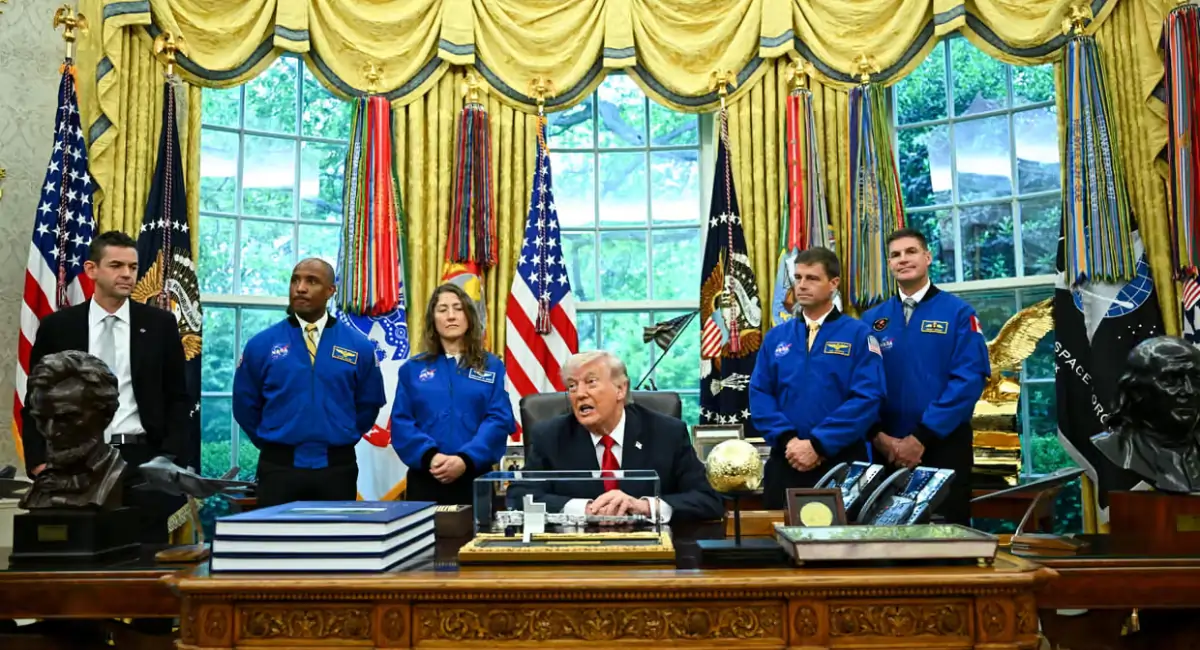
Trump himself, speaking from the Oval Office, said Iran is “dying to make a deal,” adding: “Hopefully it can be worked out very soon.”
Whether that happens on Iran’s terms, America’s terms, or no terms at all — the next few weeks will be decisive.
“Where Is Trump Now?
Trump is scheduled to speak at The Villages Charter School in Sumterville, Florida, with doors opening at 11 a.m. and his address set for 3 p.m. He will then appear at the Forum Club of the Palm Beaches at the Kravis Center for the Performing Arts in West Palm Beach at 6:15 p.m. — all confirmed by local Florida media and USA Today.