

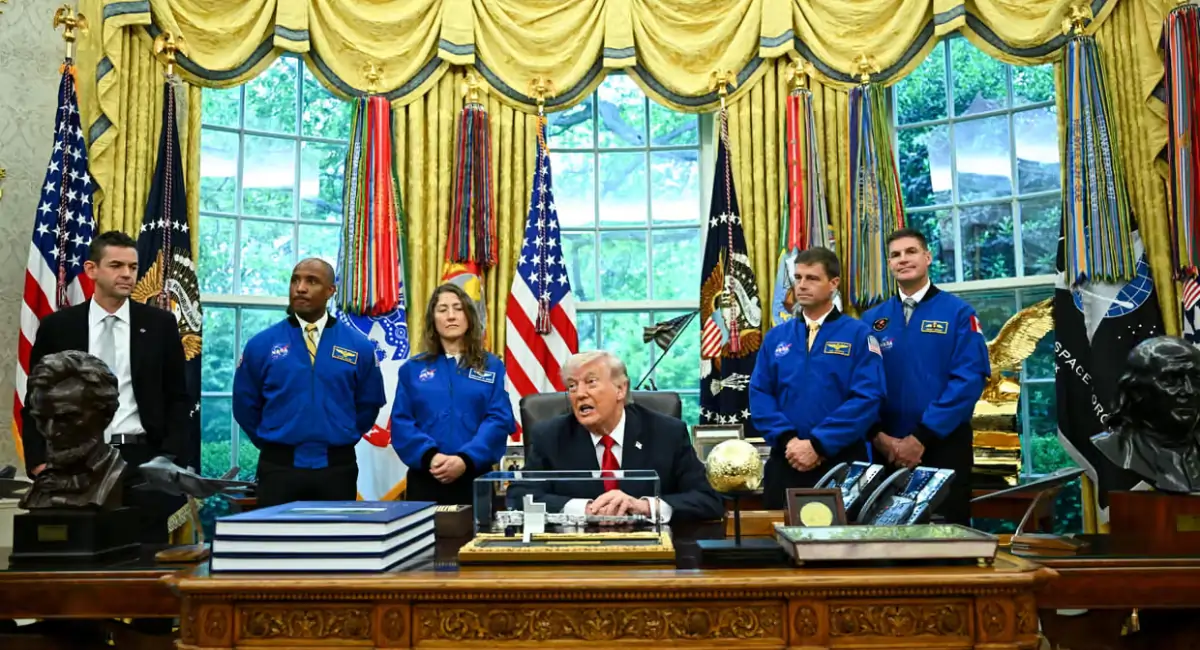
Trump News Today- After flying farther from Earth than any humans in history, the Artemis II crew made one more stop the Oval Office. On Wednesday, April 29, 2026, President Donald Trump welcomed NASA’s four-person moon crew to the White House, heaping praise on the astronauts just weeks after their record-breaking lunar mission wrapped up.
3 Main Stages of The Mission
- Artemis I – (Completed) This is a very Classify and unnamed mission without humans. In this mission testing in Orion spacecraft and SLS ( Space launch System) Rocket.
- Artemis II – (Upcoming) In this mission , Four astronauts will fly around the moon and return to Earth without land on the lunar surface to test the spacecraft’s life support system.
- Artemis III – ( The big Goal) This mission aims to land astronauts on the moon’s south pole, marking the first human lunar landing in over 50 year and exploring regions never Visited by humans before.
Based on the article and verified NASA sources, here are the three mission dates-
| Mission | Date |
|---|---|
| Artemis II | April 1–10, 2026 (completed) |
| Artemis III | Planned for 2027 |
| Artemis IV (Moon surface landing) | Two opportunities targeted in 2028 |
Who Were the Artemis II Astronauts?
The crew of Artemis II was, by any measure, a historic group. Commander Reid Wiseman, Pilot Victor Glover, Mission Specialist Christina Koch, and Canadian Space Agency astronaut Mission Specialist Jeremy Hansen made up the four-person team that orbited the Moon on April 1–10, 2026.
Each crew member broke a record:
- Victor Glover became the first person of color to travel beyond low Earth orbit.
- Christina Koch became the first woman to fly to lunar distance.
- Jeremy Hansen became the first non-U.S. citizen to travel to the Moon’s vicinity.
- Reid Wiseman became the oldest person to travel beyond low Earth orbit.
That’s not one historic milestone. That’s four in a single mission.
What Was the Artemis II Mission?
The Artemis II mission launched from Kennedy Space Center on April 1, 2026, aboard NASA’s Space Launch System (SLS) rocket, carrying the crew inside the Orion spacecraft — which the crew named Integrity. Over nearly 10 days, the crew flew a free-return trajectory around the Moon and splashed down in the Pacific Ocean off the coast of San Diego on April 10, 2026.
It was the first crewed flight beyond low Earth orbit since Apollo 17 in 1972 a gap of over five decades. Think about that: an entire generation of human beings grew up, had children, and watched those children grow up, all without a single human going back to deep space.
That changes now.
At their farthest point, the Artemis II crew reached 252,756 miles from Earth — shattering the previous record set by Apollo 13 in 1970, which stood at 248,655 miles. They broke a 56-year-old record. During the mission, the crew also covered a total of 694,481 miles, and came as close as 4,067 miles above the lunar surface during their flyby.
During the seven-hour lunar flyby on April 6, the crew observed the Moon’s far side in stunning detail, photographed an Earthset and an Earthrise, and even watched a solar eclipse from space using eclipse glasses. Yes, actual eclipse glasses. In lunar orbit. Humanity is wild.
What Happened at the White House?
On April 29, Trump hosted the astronauts in the Oval Office alongside NASA Administrator Jared Isaacman. The president opened the meeting with genuine enthusiasm, telling the crew: “You captivated the attention of the whole world, not just our country, the whole world.”
He added, with characteristic Trump candor: “They have a lot of rocket under them. I don’t know how they do it. I wouldn’t wanna do it.” Fair enough. Most of us wouldn’t want to either.
Trump had already been vocal about the mission before it launched. He watched the liftoff alongside Secretary of State Marco Rubio and later called the crew on April 6 mid-mission to congratulate them during their lunar flyby. He formally invited them to the White House during that same call.
The astronauts had also attended the State of the Union address back in February, so this White House visit was something of a reunion.
On Trump’s desk during the visit sat a gold-plated model of the Moon and a model of the Space Reactor-1 Freedom Rocket both on loan or gifted by NASA. The Oval Office had never looked quite this space-themed.

What’s Next for NASA’s Artemis Program?
The Oval Office visit wasn’t just a celebration. It also served as a checkpoint for NASA’s future plans.
Isaacman confirmed that Artemis III is scheduled for 2027, and the agency is targeting two opportunities in 2028 to return astronauts to the lunar surface for the first time since 1972. The ultimate goal is to build a permanent Moon base.
“We just sent Artemis II around the moon. We’re going to launch Artemis III in 2027. We’ll protect for up to two opportunities in 2028 to return astronauts to the surface of the moon,” Isaacman said during the White House visit.
Trump, who has consistently framed the space program as a symbol of American strength, also addressed Mars, saying: “We’ll be doing it again and then, next step, Mars!”
On the question of whether NASA’s headquarters would relocate with Florida and Texas both expressing interest ahead of the agency’s 2028 lease expiry Isaacman confirmed that NASA’s headquarters will remain in Washington, D.C., citing the value of being close to lawmakers and stakeholders. Trump agreed, though with his usual dry humor: “He’s got to go around. He’s got to see some senators.”
Following the White House visit, U.S. Ambassador to the United Nations Mike Waltz confirmed the Artemis II crew would head to the United Nations on Thursday, April 30.

Why This Mission Matters
It’s easy to let news cycles bury something this significant. But the Artemis II mission deserves real weight.
This was humanity’s return to lunar space after more than 50 years. Only about one-quarter of the world’s population was alive the last time humans flew to the Moon’s vicinity. For three-quarters of people on Earth, this was the first time in their lifetimes that astronauts had gone that far.
NASA coined the term “Moon joy” to describe the wave of global emotion that followed the mission defining it as “the feeling of intense happiness and excitement that only comes from a mission to the Moon.” That phrase came from the crew’s own public communications during the flight, which resonated with audiences worldwide in a way that surprised even NASA.
Commander Wiseman put it best during the mission: “Every time we take another step forward, it makes the world seem a little bit smaller and a little bit more manageable.”
A Historic Crew, A Historic Moment
The Artemis II White House visit was more than a ceremony. It marked the beginning of a new era in human spaceflight one where the Moon is no longer a memory from textbooks but an active destination that humans are preparing to revisit and eventually call a temporary home.
The Artemis program is ambitious. Some timelines will shift, as they always do in spaceflight. But the fact remains: four humans flew around the Moon in April 2026, broke a record that stood for 56 years, and came home safely. Then they went to the White House. Then the UN.